Chorek recipe

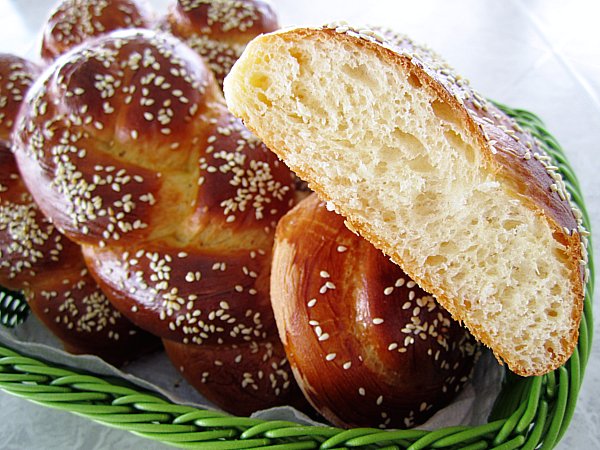
Chorek, a very traditional Armenian sweet bread that is typically made around Easter.

One of the secret ingredients in chorek that makes it different from other sweet breads is the addition of a Middle Eastern spice called mahlab, which derives from the stones of St. Lucy’s cherries. Mahlab’s aroma is reminiscent of cherry, almond, flowers, and rose water, and it imparts a sweet/sour and nutty flavor with a slightly bitter aftertaste. It’s a common addition to breads, pastries, and other sweet confections of the Middle East and Eastern Mediterranean. It is more readily available around Easter time and can be purchased at Middle Eastern or Greek markets, or even online. Once ground, it looses it’s flavor and aroma rapidly, so store in an air-tight container and refrigerate or freeze for longevity, or purchase the spice whole and grind it yourself before each use. If mahlab is unavailable, it can be omitted from the recipe, but the traditional sweet aroma that makes chorek what it is will be missing.

Chorek is generally prepared into smaller shapes as opposed to large loaves, and is sprinkled with sesame seeds and baked until a dark golden brown. Most commonly, it is braided much like challah, but with 3 strands as opposed to the traditional 6 strand challah braid. It can also be shaped into snails, twists, or my personal favorite… chorek people! Chorek people look a lot like gingerbread men, but they are made of yeasted dough and therefore require a bit more effort to shape than using a cookie cutter.

The only problem with chorek people is that they can be a bit more dry than the other shapes because their “parts” (legs, arms, etc) are slightly thinner than the other shapes and can dry out more easily when baking. They still taste delicious, but flavor and texture-wise. Make smaller braids for individual portions or slightly larger ones to slice up and share.
INGREDIENTS

Chorek (Armenian Sweet Bread)

Makes about 18, depending on size and shape

  • 2 (1/4 oz) envelopes dry active yeast
  • 1/2 cup warm water
  • 1 cup plus 1 tsp. sugar
  • 2 1/4 sticks (9 oz) unsalted butter
  • 1 cup milk
  • 5 eggs, at room temperature
  • 1 1/2 tsp. whiskey or brandy
  • 1 tsp. pure vanilla extract
  • 2 1/2 lbs (40 oz) all-purpose flour, plus more for dusting
  • 2 tsp. ground mahlab
  • 1 tsp. baking powder
  • 1/8 tsp. salt
Decorations and Eggwash
  • Whole cloves, as needed (optional)
  • Red M&Ms, as needed (optional)
  • 1 whole egg
  • 1 egg yolk
  • 1/2 tsp. sugar
  • Sesame seeds, as needed

INSTRUCTIONS

  1. Mix together yeast, warm water, and 1 tsp. sugar and set aside to rise, approximately 10 to 15 minutes.
  1. Meanwhile, melt the butter and warm up the milk to a simmer in separate saucepans.
  1. In a mixing bowl, beat the eggs with the remaining 1 cup sugar, whiskey and vanilla extract. Then slowly add the hot milk, beating constantly (to gently warm the eggs), followed by the melted butter until well combined. Then beat in the yeast mixture. The liquid mixture should be fairly warm.
  1. In a large mixing bowl, combine the flour, mahlab, baking powder, and salt. Create a well in the center of the dry mixture and pour in the liquid mixture. Use a large spoon to gently mix the dry mixture into the liquid, starting from the center and moving outward until all the dry mixture is moistened. Start using your hands to finish mixing and knead the dough. If it is too wet and loose, add more flour and continue kneading until you have a soft, pliant, and slightly sticky but not-too-wet dough.
  1. Place the dough in a large greased bowl (make sure that the bowl is considerably larger than the dough, as it will rise), and loosely cover dough with a piece of greased aluminum foil.
  1. Briefly heat the oven and then turn it off. Place the dough in the warmed oven and allow it to double in size, approximately 2 to 3 hours. Check on the dough occasionally to see its progress.
  1. On a floured surface, shape the dough into desired shapes**. Place onto greased baking sheets (leaving adequate space between the choreks as they will rise and expand further during baking). You will need about 3 half sheet pans for this amount of dough.
  1. Place baking sheets back into a warmed oven (make sure the oven is turned off) to allow the choreks to proof, approximately 15 to 30 minutes. Remove from the oven.
  1. Preheat the oven to 350 degrees F. Beat the egg, egg yolk and sugar together and brush all the choreks (including the sides) with the egg wash mixture. Sprinkle with sesame seeds (but omit sesame seeds for chorek people shapes).
  1. Bake choreks for 22 to 28 minutes until dark golden brown (baking time may be dependent on the size of your choreks), rotating the baking sheets from top to bottom and front to back halfway through to ensure even baking.
  1. Allow choreks to cool completely before serving. Choreks should be stored at room temperature, but can be warmed up before eating, if desired. They can also be frozen, thawed, and enjoyed at a later date.

*Note* This recipe can easily be doubled (we usually do to make enough to share with relatives). Simply use a whole 5-lb bag of all-purpose flour (no need to weigh it!) and double all the other ingredients as well.

  1. To make chorek shape
  • To make the braid shape: Lightly flour your work surface and hands, and roll out a piece of dough between your hands and the work surface until you have a 1/2-to-3/4-inch thick rope. Cut off 1/3 of the length of the dough and attach it to the center of the longer piece but pressing the pieces together. Very loosely braid the ropes together (the braid will proof and get bigger later, so don’t braid tightly). Press the ends together to “seal” the braid.
  • To make the snail shape: Lightly flour your work surface and hands, and roll out a piece of dough between your hands and the work surface until you have a 1/2-to- 3/4-inch thick rope. Gently and loosely wrap the dough around itself starting from the center and moving outward. Tuck the end under the dough and gently press to seal it closed.
  • To make a chorek person: Lightly flour your work surface and hands, and roll out a piece of dough between your hands and the work surface to create an even cylinder. Pat the dough out into a rectangle with the long sides on either side. Use a bench scraper or knife to cut a slit at the bottom (for the legs), 2 slits on either side (for the arms) and another 2 slits slightly above the arms (for the head). Tuck under the pointy ends of the arms. Adjust the dough around the head to either make it look like hair (for a girl), or tuck the points under the head to make it round (for a boy). Use whole cloves for the eyes, and red M&Ms for the mouth. Very carefully use a large floured spatula to transfer chorek people from the work surface to the greased baking sheet. They are more fragile than the other shapes. Remove the clove eyes before eating.
  1. Enjoy!

Gutap recipe

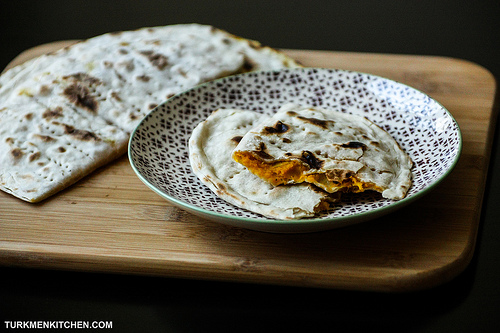
Dürüşde gutap are fried pastries typical of Turkmenistan . 

To prepare them, starting with the dough , mixing water, salt, yeast and flour of wheat ; knead until you get a ball, cover with a cloth and let it grow. For filling , stir – frying oil onion and cabbage chopped, add meat ground (or finely chopped) and cook; This transfer for cooking bowl , add rice cooked mash of potato , salt and pepper and mix. Roll out the dough into a thin layer and cut slices about 12 cm in diameter; put a spoonful of stuffing in the middle, fold and close. Fry the pastries in very hot oil .

Deep-Fried Gutap (Cheburek)

Makes 16 gutaps

INGREDIENTS

For the meat filling
  • 500 g ground beef or lamb
  • 1 onion, ground or finely chopped
  • ½ teaspoon salt
  • Pinch of ground black pepper
  • Pinch of red pepper flakes
  • 2 tablespoons water
For the spinach filling
  • 1 kg fresh spinach
  • 8 tablespoons vegetable oil
  • 3 tablespoons flour
  • 6 tablespoons water
  • 1 teaspoon salt
For the dough (enough for one filling)
  • 1 teaspoon salt
  • 300 ml warm water
  • 500 g flour
  • Vegetable oil, for deep-frying

INSTRUCTIONS

  1. To make filling
  • Meat filling: Mix all the meat filling ingredients thoroughly.
  • Spinach filling: Bring a large pot of water to a boil over high heat. Rinse the spinach and add it to the pot. After 5 minutes, scoop out the spinach with a slotted spoon and, to preserve its green color, put it in a bowl of cold water. Drain the spinach again and then crush it with a wooden spoon. Heat the oil in a pan over medium heat. Stir in the flour. When the flour turns slightly brown, add the water and stir 5-6 times. Add the crushed spinach and salt. Stir well and turn off the heat.
  1. In a large bowl, mix all the dough ingredients together and knead to a smooth dough. Divide the dough into 16 equal pieces and roll each piece between your palms into a ball. Cover the dough balls with a kitchen towel and allow to rest for 5 minutes.
  1. Take a ball of dough, sprinkle some flour and roll it out to a 14 cm circle. Spread 1 tablespoon of the meat or spinach filling on half of the circle while leaving a thin border. Fold the other half over and then crimp along the edge with a fork. Transfer the gutap to a tray covered with a kitchen towel and place another towel on top so that the gutap doesn’t stick to the tray or harden. Repeat with the remaining dough balls.
  1. Fill a large pot about 4 cm deep with oil and heat over medium heat. Prick the top of each gutap with a fork. Deep-fry the gutaps in batches of 2, flipping them once, until golden brown on both sides, and then take them out with a slotted spoon.
  1. Enjoy!

Dograma recipe

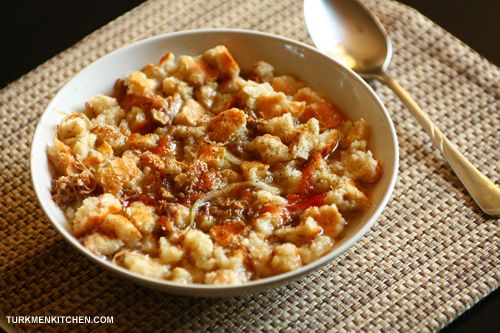
Simplicity can sometimes yield a culinary miracle. Dograma, a simple and nourishing stew of shredded meat, bread and onions from Turkmenistan, is one of those miracles.

Dograma — the name comes from the Turkmen word meaning “to chop up” — is special occasion food and is sometimes called the national dish of Turkmenistan. Huge amounts are made for religious holidays and other celebrations, and preparing it can be an all-day affair.

To start, large amounts of çörek, a pita-like flatbread, are baked in tandyr ovens. Separately, large pots of mutton or beef simmer slowly in water with just a little chopped tomato and salt added for flavor.

Once the bread is baked, it is torn into small pieces — the whole family usually chips in with this task — and the bread gets tossed with thinly sliced onion.

When the meat is falling-off-the-bone tender, it is shredded by hand and mixed with the bread and onions, along with a good grinding of pepper. The whole lot is then put into large serving bowls and the simmering meat broth is poured over to moisten everything. After the flavors and textures have melded for a bit, the delicious dish is portioned out for well deserving diners.

If that sounds like more work than you’re willing to put in at home, never fear! Making a family-sized batch is actually very easy. Buy prebaked pita, and you can whip up a tempting batch in an hour or less.

INGREDIENTS

  • Mutton, lamb or beef stew meat, cubed — 2 1/2 to 3 pounds
  • Water — 3 quarts
  • Tomatoes, seeded and chopped — 2 or 3
  • Salt — 1 tablespoon
  • Naan or pita-style breads — 4 or 5
  • Onions, thinly sliced — 2 or 3
  • Salt and pepper — to season

INSTRUCTIONS

  1. Add the meat, water, tomatoes and salt to a large pot and bring to a boil. Skim off any scum that rises to the surface, then reduce heat to medium, cover and simmer for 1 to 1 1/2 hours, or until the meat is cooked through and tender. (Note: Using a pressure cooker will cut the cooking time in half and make your meat even more tender and your broth richer).
  1. While the meat is cooking, cut or tear the pita or naan bread into small (1/2-inch) pieces. Add the pieces of bread to a large bowl, along with the sliced onions and a good grinding of pepper. Toss and set aside to rest and mix the flavors.
  1. Remove the cooked meat from the broth with a slotted spoon. Use clean hands or a fork to shred the meat. Add the meat to the bowl with the bread and onion mixture and toss well.
  1. Pour the hot meat broth over the mixture in the bowl, and then cover the bowl with a towel or plastic wrap and set aside to rest for 20 to 30 minutes to allow the flavors and textures to meld.
  1. Portion out into bowls and decorate your meal
  1. Enjoy!

Mantu recipe

Manti (Kazakh: мәнті, mänti, مأنتى, Turkish: mantı, Uzbek: manti, monti, Armenian: մանթի), also manty (Kyrgyz: манты; Russian: манты; Tatar: манты), mantu (Pashto, Persian, Arabic: منتو‎; Tajik: манту) or manta (Uyghur: مانتا‎, manta, monta, манта, монта), is a type of dumpling popular in most Turkic cuisines, as well as in the cuisines of the South Caucasus, Central Asia, Afghanistan and Chinese Muslims. Nowadays, manti are also consumed throughout Russia and other post-Soviet countries, where the dish spread from the Central Asian republics. The dumplings typically consist of a spiced meat mixture, usually lamb or ground beef in a dough wrapper and either boiled or steamed. Size and shape vary significantly depending on the geographical location. Manti resemble the Chinese jiaozi and baozi, Korean mandu, Mongolian buuz and the Tibetan momo and the dish’s name is cognate with the Korean mandu, Chinese mantou and Japanese manjū, although the Chinese and Japanese counterparts refer to different dishes.

The name, depending on the language, can refer to a single dumpling or to more than one dumpling at a time; in English, it is often used as both a singular and plural form.

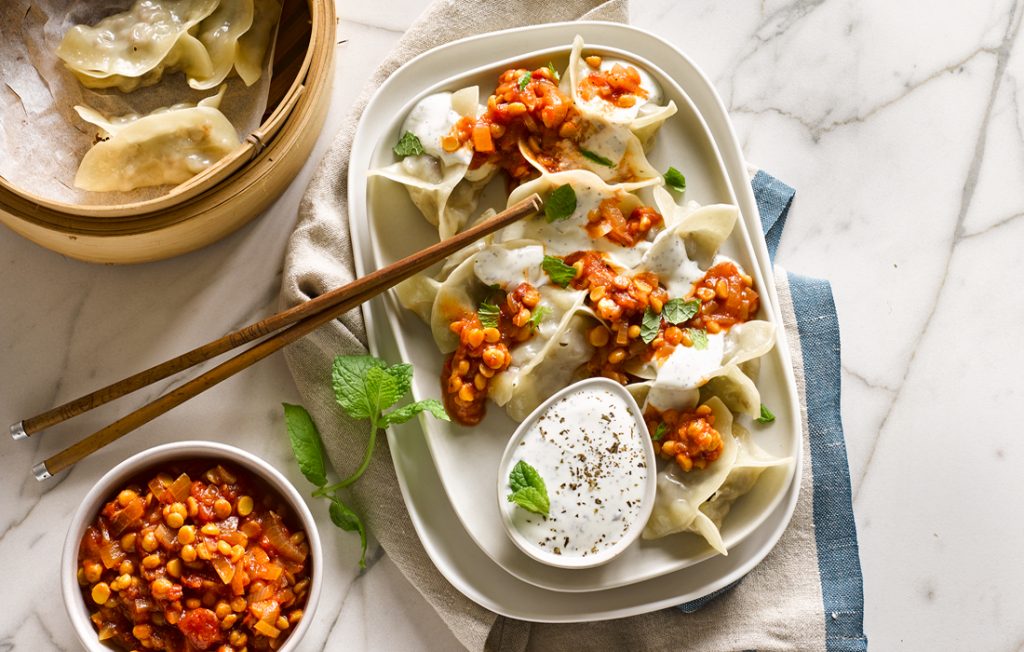
 the mantu are filled with beef or lamb mixed with minced onions and spices, steamed and then topped with a very typical sauce (seer mosst, lit. ‘garlic yoghurt’) of yoghurt, dried or fresh mint, lemon juice and minced or pressed garlic. The mantu are also typically topped with a very small amount of tomato-based sauce which can include split peas, red kidney beans and/or some sautéed ground meat. The amount of yoghurt sauce is typically much greater than the tomato sauce; the tomato sauce is meant to be dotted on top – not covering the dish. Chutney, a spicy green or red pepper condiment sauce, may be sprinkled on top. Many Afghans also like to serve mantu with a carrot qorma or stew, instead of a tomato-based sauce.

INGREDIENTS

Filling
  • 2 cups of Onions
  • 1 pound of Ground Beef/Lamb
  • ½ tsp. Garlic
  • 2 tsp. Coriander Powder
  • ½ tsp. Salt
  • ½ tsp. Black Pepper Powder (freshly ground)
 Topping
  • 1 cup Chana Lentils
  • ½ pound Ground Beef/Lamb
  • 1 medium Onion (finely chopped)
  • ½ tsp. Garlic
  • ½ tsp. Salt
  • ½ tsp. Black Pepper Powder (freshly ground)
  • 2 tsp. Tomato Paste
  • 30 ml. Cooking Oil
Yogurt dip
  • 1 tsp. Dried Mint Leaves
  • ½ tsp. Garlic
  • ½ tsp. Salt
  • 500 ml. Plain Yogurt

INSTRUCTIONS

Filling
  1. Heat pan over a medium heat and add garlic, ground beef and salt and coriander. Cook until the meat is half-way cooked for about 15 to 20 minutes.
  1. Add black pepper and remove from heat.
  1. Combine one cup of raw chopped onions to the meat and let it cool down to room temperature
Sauce topping
  1. Soak split peas for 2–3 hours or overnight.
  1. Heat oil in a frying pan and cook onion and garlic until lightly browned.
  1. Add tomato and tomato paste. Add split peas and ¾ cup water and cook for 30–45 minutes until soft.
  1. Season with salt and pepper and set aside.
Yogurt dip
  1. Combine all of the ingredients for dip in a bowl and mix well.
Pastry (if making)
  1. Place flour in a large mixing bowl and gradually add water, mixing with hands until it becomes doughy.
  1. Leave the dough to settle for 15–20 minutes or until it becomes firm.
  1. Separate dough into small handfuls and roll into individual ball shapes.
  1. Scatter some flour on the bench surface and using a small rolling pin, roll the balls into circular shapes.
Mantu
  1. Roll the dough ball into a very thin (1/16-inch) strips using a pasta machine. Cut the strips into 2-inch squares.
  1. Place approximately one tablespoon of the cooled ground beef and onion mixture onto each wrap. To make the wraps stick together easily, wet the edges with water (you may use your fingers or a basting brush).
  1. Fold over first two opposite ends of the egg roll wrap and followed by other two ends to enclose dumplings. Press the edges tightly to seal together. Continue with the remaining wraps.
Cooking
  1. Take the racks out of the steamer dish. Add water to the dish, cover and bring to boil.
  1. Oil the base of steamer to prevent sticking and place dumplings carefully across oil.
  1. Cover lid and cook for approximately 40 minutes.
  1. When the dumplings have cooked, add a thin layer of the yogurt mixture to a large serving plate. Place the steamed dumplings on top.
  1. Pour some more of the yogurt mixture on top of the dumplings and coat everything with the the topping sauce.
  1. Garnish with dried mint and a little bit of cayenne pepper.
  1. Enjoy!

Ashak recipe

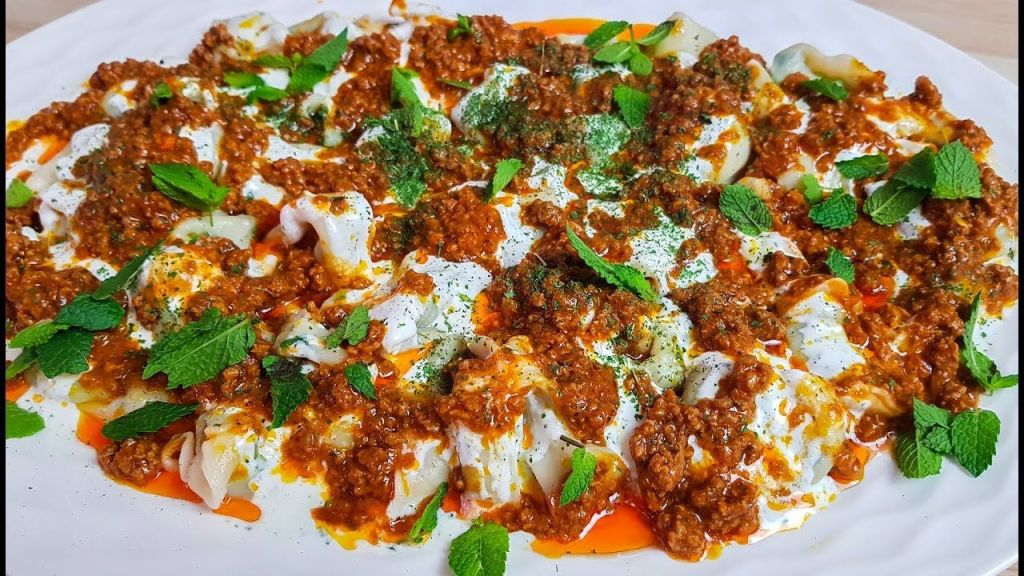
Aushak, also spelled ashak [Pashto/Persian: اَشَک], is an Afghan dish made of pasta dumplings filled with chives, with a (frequently meaty) tomato sauce, topped with yogurt and dried mint. A time-consuming meal to prepare, it is usually served on holidays or at special gatherings.

INGREDIENTS

  • Qurma Dal Nakhod (Chana Dal)
  • Ashak Dough
  • Mix Curd (Afghani )
For leek mixture
  • Nira Herb (Chinese Leek): 1/2 Bunch
  • Extra Virgin Oil: 2 Tablespoons
  • Sea Salt: 1/2 Teaspoon
  • Coriander Powder: 1 Teaspoon
  • Black Pepper: 1 Teaspoon
  • Dried Mint: 1 Teaspoon
  • Water For Boiling: 6-8 Cups

INSTRUCTIONS

For leek mixture
  1. Wash and cut the leek.
  1. Add salt,black pepper, coriander powder and oil to make the leek mixture. Set aside
Making the Ashak
  1. Make small ball from the dough and flatten to make it thin using rolling pin or pasta machine.
  1. Now, cut circle shapes out of flattening dough using a cutter.
  1. Add a little leek mixture in the middle of it and close two sides to make a moon shape. Make sure to seal all around.
  1. Boil water like you boil for making pasta. OR use a steamer easy and clean to steam the Ashak for 25 minutes.
  1. After boiling the Ashak in water for 5-7 minutes, add a layer of Mix Curd on a flat plate and place the Ashak in the plate.
  1. Then add some more Afghani Mix Curd on it, and sprinkle some Qurma Dal Nakhod.
  1. Finally, finish it with sprinkling some dried mint and cayenne on the top.
  1. Enjoy!

Bolani recipe

Bolani (Persian: بولانی‎), or Perakai (Pashto: پيراک‎), Poraki (Persian: پُرکی‎), is a flat-bread from Afghanistan, baked or fried with a vegetable filling. It has a thin crust and can be stuffed with a variety of ingredients, such as potatoes, lentils, pumpkin, chives, or leeks. It can be served with plain yogurt or mint yogurt.

Bolani is made for special occasions like birthday parties, engagement parties or holidays.

In America, the Bolani is the quintessential food item at any Kabob House. The variations are endless. Toppings typically include chives, potato, lentils, leeks and other vegetables. However, it is not limited to traditional toppings; items such as falafel, gyro meat, carne asada and bacon and all fair game. The dough is only limited to the imagination. While white flour is common, many enthusiasts prefer whole wheat or rye.

INGREDIENTS

Dough Ingredients
  • 3 ½ c all-purpose flour
  • 1 c water room temperature
  • 1 tsp salt
  • 1 tsp olive oil
Filling Ingredients
  • 2 medium potatoes
  • ½ c chopped cilantro
  • ½ c chopped scallions (white and green parts)
  • 2 tbsp. olive oil
  • 1 ½ tsp salt
  • 1 tsp ground black pepper
For frying
  • ¼ c olive oil
Yogurt Sauce
  • 1 c plain greek yogurt
  • 2 tbsp water
  • 1 garlic clove, minced
  • 1 tsp dried dill
  • ¼ tsp coriander
  • ½ tsp salt

INSTRUCTIONS

Dough
  1. Mix flour and salt together. Gradually (while mixing) add in water and oil until dough forms a ball. If the dough is too dry, add more water one tablespoon at a time.
  1. Knead dough for 10 minutes.
  1. Place dough in lightly oiled bowl, cover with a cloth, and let rest for one hour.
Filling
  1. Scrub potatoes clean, place in a pot, cover by 2 inches with cold water, add a good pinch of salt, and bring to a boil over high heat.
  1. After boiling for 20 minutes, check to see if the potatoes are done by poking them with a skewer. The skewer should easily pierce through the center of the potato. Try not to check the potatoes too much, as the holes allow water to seep into the potatoes as they cook. Smaller potatoes may get done sooner than larger ones.
  1. Once the potatoes are done, drain them and let sit for 5-10 minutes.
  1. Peel and quarter the potatoes. Mash with 2 tbsp olive oil, salt, and pepper. Try to get this as smooth as possible, but keep in mind having some lumps is ok.
  1. Add in cilantro and scallions, continue mashing to combine.
Assembling and cooking the bolani
  1. Take a portion of the dough (about the size of a small apple) and roll it into a smooth ball.
  1. Spread some flour onto your surface, and roll the ball with a rolling pin. The dough should be as thin as a tortilla and have a 10-12 inch diameter. The thinner, the better!
  1. Spread a little more than 1/4 c of the filling on one half of the dough, leaving about 1/4 inch border around the rim.
  1. Fold the dough in half over the filling and press to seal. If necessary, continue pressing and flattening the bolani to remove any excess air inside the pocket.
  1. Heat 1/4 c olive oil in a pan. The oil should be hot enough that the bolani sizzles when placed in the pan. Brown the bolani, two at a time, until golden and crispy on both sides. This will only take a couple minutes on each side.
  1. Place cooked bolani on a paper towel or plate as they finish. Add more oil to your pan as needed while you cook the rest.
  1. Serve warm with a simple yogurt sauce of plain yogurt, garlic, dill, coriander, and salt.
  1. Enjoy!

Shashlik sticks recipe

Shashlik, or shashlyk, is a dish of skewered and grilled cubes of meat, similar to or synonymous with shish kebab. It is known traditionally, by various other names in the Caucasus and Central Asia, and from the 19th century became popular as shashlik across much of the Russian Empire.

While it is not unusual to see shashlik today listed on the menu of restaurants, it is more commonly sold in many areas in the form of fast food by street vendors who roast the skewers on a mangal over wood, charcoal, or coal. It is also cooked in outdoor environments during social gatherings, similarly to barbecue in English-speaking countries.

INGREDIENTS

  • 1/2 kg chicken boneless cubes
  • 1/2 tsp. salt
  • 1/2 tsp. black pepper
  • 1/2 tsp. mustard powder
  • 1 tsp. ginger garlic paste
  • 4 tbsp. ketchup
  • 2 tbsp. soya sauce
  • 1/2 tsp. red chili powder
  • 1 capsicum, cut in cubes
  • 2 tomatoes, cut in cubes after removing seeds
  • 1 cup pineapple cubes
  • 2 tbsp. oil
  • 1 lemon

INSTRUCTIONS

  1. Marinade chicken cubes in salt, black pepper, red chilies, mustard powder, ginger garlic paste, ketchup, soya sauce. Leave it for 1 hour or you can also leave it in fridge for overnight.
  1. First, soak your wood sticks in water for five minutes. Now thread chicken, tomato, capsicum and pineapple in it. Repeat and fill all your sticks.
  1. Heat pan or grill and apply a little oil . Cook them on low heat and turn after 5 minutes.
  1. Squeeze lemon juice over all sticks when they are ready. Serve hot
  1. Enjoy!

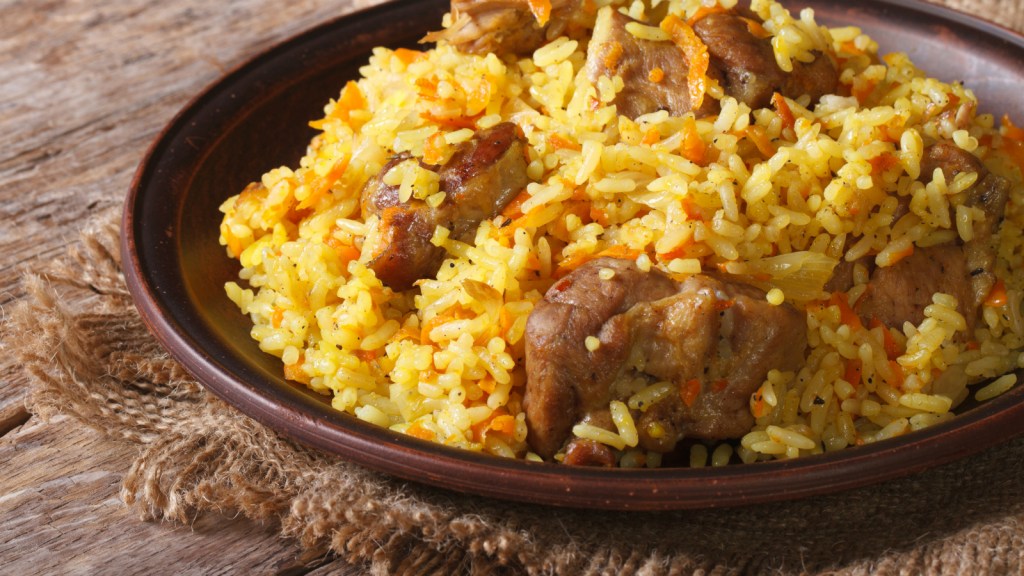
Plov recipe

Plov (also known as pilau roast and pilaf ), is a delicacy, rice is cooked in meat broth (broth). In some cases, the rice can also achieve its brown color by stirring with a little cooked onions, as well as a mixture of spices. Depending on the local cuisine, it also has meat and vegetables. Pilaff and similar dishes popular Balkan, Middle East, Central and South Asia, East Africa, Latin America, and Caribbean cuisine. The term pilaf in English is borrowed directly from Turkish , palov and / or Uzbek , palov , which is borrowed from the ancient Persian polow(پلو), and the word is borrowed from Sanskrit pulāka- (पुलाक), “boiled rice”. The English term is influenced by modern Greek pilafi .

INGREDIENTS

  • 1 1/2 lbs Beef chuck, beef sirloin or good quality beef stew meat
  • 1/3 cup canola oil, or extra light olive oil (not extra virgin)
  • 2 medium onions, finely chopped
  • 3 medium carrots, cut into matchsticks or grated
  • 1 tsp salt for the meat and veggies + 1 1/2 tsp salt for the rice
  • 1/2 tsp freshly ground black pepper
  • 1 tsp paprika
  • 1 tsp cumin
  • 3-4 bay leaves
  • 1 3/4 cups hot water for braising meat
  • 3 cups long grain rice (Basmati or Jasmin rice work great!)
  • 4 cups hot water when cooking rice
  • 1 head of garlic
  • 1 tsp ground coriander

INSTRUCTIONS

  1. Trim beef of excess fat and sinews (aka the chewy stuff), pat the meat dry with a paper towel and chop into 1/2″ to 3/4″ pieces.
  1. Preheat your dutch oven (or your large soup pot with a heavy bottom), to high heat. Once it’s hot, stir in your 1/3 cup canola oil. Once oil is hot, add chopped meat and saute uncovered 7 min over high heat until meat is browned, stirring every minute or so so it doesn’t scorch to the bottom of the pan.

Note: it’s important to preheat the dutch oven first for the meat to sear over very high heat, otherwise it will juice out and become dry. 

  1. Reduce heat to medium and Add chopped onion, stirring often until onion is softened (5 minutes). Stir in sliced carrots, 1 tsp salt, 1/2 tsp pepper, 1 tsp paprika, 1 tsp cumin, 3-4 bay leaves and continue to cook over medium heat 5 minutes until carrots are softened.
  1. Add 1 3/4 cups hot water, cover & simmer over medium/low heat 45 min or until meat is tender.
  1. Meanwhile, rinse rice until water runs clear, then drain and set aside (this gets rid of the starch so you won’t end up with a sticky rice). This thing is so versatile (from sifting flour, rinsing and draining, to wearing it as a helmet and chasing your toddler around the house).
  1. Spread rice over the meat and add 4 cups hot water. Sprinkle the rice with 1 1/2 tsp salt (DO NOT STIR), bring to a boil then reduce heat to medium and Let cook uncovered until most of the water is absorbed (10 min).
  1. Cut off the head of your garlic to expose the cloves. Put your head of garlic, cut side down into the center of the rice and sprinkle the top of the rice with 1 tsp ground coriander.
  1. Poke 7-10 holes through the rice to allow steam to escape to the surface,  reduce the heat to low, then cover and cook an additional 15 minutes or until rice is cooked through. Remove the garlic head and bay leaves and stir everything gently to combine and you’re done.
  1. Enjoy!

Beshbarmak recipe

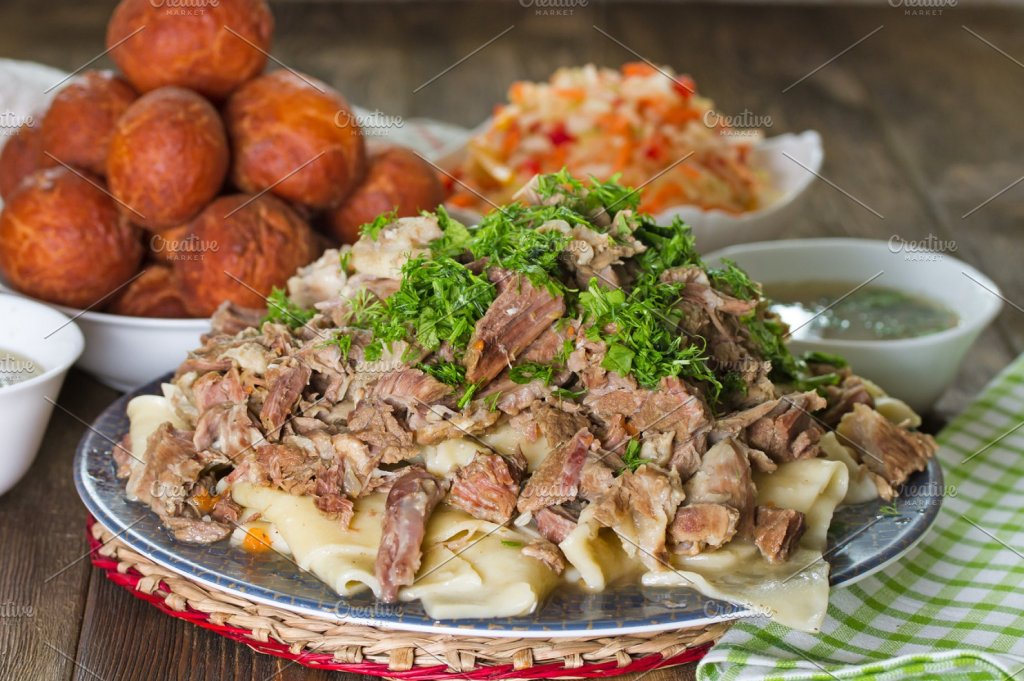
Beshbarmak (Kyrgyz: бешбармак, Russian: бешбармак, Bashkir: бишбармаҡ, Tatar: бишбармак — “five finger”) is the national dish among nomadic Turkic peoples in Central Asia and Russia. It is also known as naryn in Xinjiang, Uzbekistan, Kyrgyzstan and Kazakhstan, as turama or dograma in Karakalpakstan, North Caucasus and Turkmenistan, and as kullama in Bashkortostan and T atarstan.

The term beshbarmak means “five fingers”, because nomads used to eat this dish with their hands. The boiled meat is finely chopped with knives, mixed with boiled noodles, and spiced with onion sauce. It is usually served in a big round dish. Beshbarmak is usually served with shorpo – mutton broth in bowls called kese. Typically, shorpo is served as a first course that is followed by courses of beshbarmak and a drink called ak-serke (shorpo spiced with kymyz or ayran).

INGREDIENTS

  • 1-1/2 lean beef chuck  (Any cut will do, really. Even the fattier ones. You can even add a bone or two)
  • 3 L of water
  • 2-1/2 TBSP salt
  • 2 eggs
  • 1 cup of warm water
  • 2 cups of all purpose flour (have some more on standby)
  • 2 medium potatoes
  • 1 large onion
  • 1 carrot
  • 1 TBSP cumin seeds
  • 1 tsp black pepper
  • More water to cook the dough squares
  • 1TBSP ghee (or butter), 1 TBSP avocado oil to caramelize the onions
  • Dill for garnish

DIRECTIONS

  1. In a medium-size pot place the meat, pour 3 L of water, add 1 TBSP of salt. Turn the heat on and bring the water to a slight boil.
  1. Once the foam starts forming, use a skimmer and remove the foam. At this time turn the heat down and keep simmering the broth. You may also cover the pot with a lid halfway in order to help the meat cook faster.  Or you may also use your pressure cooker, or Insta Pot to do this job for you. Simmer the broth until the meat is completely cooked and tender. This process will probably take from 40 minutes to an hour. In Insta Pot the meat and the broth will be ready in 20 minutes.
  1. While the meat is boiling start working on the dough. Place warm water, 1/2 TBSP of salt and 2 eggs in a medium-size bowl. Give all the ingredients a stir with a fork.
  1. Start adding the flour, 1 cup at a time. Incorporate the first cup, add the second and see if you will need more. Flour is different for everyone. Cups are different everywhere. But the dough should not be too hard and not too soft, as to stick to your hands.
  1. Knead the dough well. Once you are done keep the dough in the bowl and cover with the lid. Let the dough rest for about 15 minutes before it is ready to be rolled out. Usually, I don’t disturb the dough until I am ready to roll it and cook it right away. Meanwhile, prep the vegetables, which will go into the gravy broth.
  1. Potatoes are not a usual occurrence in Besbarmak. But I love potatoes in this dish. Frankly, I haven’t heard anyone complaining about it either. Cut the potatoes in small cubes.
  1. You can cut carrots however you want. My family doesn’t like cooked carrots much. So, it goes in the broth for the taste only. I roughly chop the carrot and keep it ready until further use.
  1. Slice the large onion and divide the end result in half. One half will go into the broth, the other half will be caramelized to be used as garnish.
  1. By this time I am assuming the meat will be fully cooked. Take out the cooked meat. The broth from underneath the meat is golden. Do not discard it. I place a quarter of the remaining broth in a large pot where I will be cooking the dough. The rest of the broth will remain in the original dish.
  1. Turn the heat back on under the original pot where the meat was cooking. Add the cubed potatoes, carrots and half of the onions into the broth.
  1. Cube the cooked meat and return it back into the pot with the vegetables.
  1. Add cumin, black pepper and if you think the broth is low, add a little bit of water. The rule of thumb is, when the vegetables cook through, you should have a good amount of liquid to cover the dough with some broth. Check the salt of the broth. Adjust the salt and simmer this mixture.
  1. In a small skillet place the ghee and the TBSP of liquid oil of your choice. Turn the heat to medium and add the remaining onions.
  1. Slowly but surely cook the onions. They will become translucent first, then they will start changing color. At this time be cautious and stir the onions periodically. They might burn pretty quickly. Once the color turns light golden brown, you can turn off the heat and remove the skillet from the cooktop. If you leave the skillet on the hot cooktop, onions might keep on caramelizing further. This is what we do not want! Keep the onions aside until assembly of the dish.
  1. Above is how your ready gravy will look like. All the vegetables are cooked and ready to be served on top of a tender dough.
  1. Right before rolling out the dough, make sure to turn on the heat under a large pot where you are going to cook the dough pieces. Remember the broth that you’ve saved for this purpose? The entire liquid is not going to be just that broth. Add about 2 liters of water on top of that broth, add 1/2 TBSP salt and let the water come to boil while you are rolling the dough. Turn the heat down just a tad bit until the dough is ready.
  1. Now we come to a tedious part of the recipe; rolling the dough. Remove the dough from the bowl it was in. Lightly flour the surface, flour the dough just a bit and start off with creating an even-sided pancake. The flatter and larger the pancake gets, easier it will be to start rolling the dough.
  1. When you have a large enough surface, latch one side of the dough onto the rolling pin and start expanding the circle. Use flour as needed in order to avoid dough sticking to itself.
  1. Like I mentioned above, this recipe requires the ability to roll the dough. I cannot really recommend going with any substitutions for this; unless you can find thin enough wonton wrappers or dumpling wrappers. If the wonton dough is a little thicker, you can always roll it out thinner and have the dough ready. OR you can use a dough roller machine or an attachment that comes with your Kitchenaid Mixer. Whichever works for you.
  1. The dough should be on a thin side. We are creating somewhat translucent dough pieces to have that perfect balance Beshbarmak has. Roll the dough around the rolling pin, and slowly unroll it to a stack, in one line, by using a zigzag motion. A strict width doesn’t really matter. Anywhere between 4-6 inches should work.
  1. Using a sharp knife slice the dough ‘log’ into 4-inch strips. Once you are done cutting all the strips, move everything to the side. Spread each dough one by one, one on top of another and create one line.
  1. Cut the dough stack into 2-4 inch squares. I like to cut mine into 2. The dough is more manageable this way and I can spread the dough into portions much easier.
  1. Assuming the water is readily boiling, quickly work to drop dough squares into the boiling water. You will have to singlehandedly drop every little square into the water in order to avoid dough sticking to each other while cooking. Don’t just through stacks of dough. Having more than 2 hands would work wonders during this process 🙂 But it is nothing I haven’t done many times and you will be just fine! Cook the dough for about 4 minutes. If the water is overboiling, turn the heat down to medium.
  1. Keep serving dishes ready to divide the dough into portions. Using a big skimmer take the dough out and spread it on the plates you are going to serve them in. These are going to be individual portions.
  1. Spread the gravy on top of the dough, add some of the broth, garnish with caramelized onions and dill. I feel like dill goes splendidly well with this particular dish. You can also garnish it with raw onions. The cooked carrots can go on top as a garnish, too. The colors will look amazing. If you do not like cooked carrots, you may take them out.
  1.  Enjoy!

Beef noodle (phở) recipe

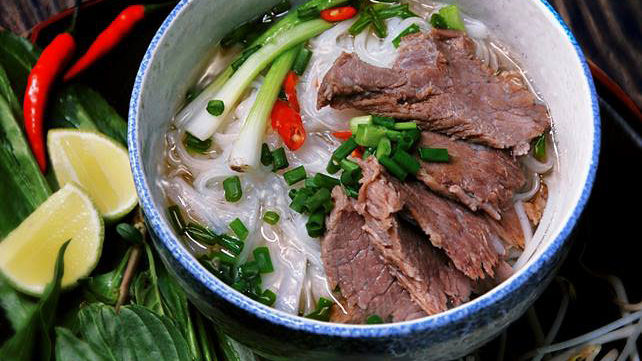
Phở or pho (UK: /fɜː/, US: /fʌ, foʊ/, Canada: /fɔː/; Vietnamese: [fəː˧˩˧]) is a Vietnamese soup consisting of broth, rice noodles (bánh phở), herbs, and meat – usually beef (phở bò), sometimes chicken (phở gà). Pho is a popular street food in Vietnam  and served in restaurants around the world.

Pho originated in the early 20th century in northern Vietnam, and was popularized throughout the world by refugees after the Vietnam War. Because pho’s origins are poorly documented, there is disagreement over the cultural influences that led to its development in Vietnam, as well as the etymology of the name. The Hanoi (northern) and Saigon (southern) styles of pho differ by noodle width, sweetness of broth, and choice of herbs.

INGREDIENTS

  • 1kg chopped beef bones
  • 250g cheap beef cuts (cheek)
  • 2.5L cold water
  • 4 cloves garlic
  • 30g root ginger, sliced
  • 2 shallots, peeled and cut in half
  • 3cm piece of cinnamon stick
  • 3 star anise
  • 1 black cardamom pod, cut in half
  • 4 tbsps fish sauce 400g fine rice noodles
  • 2 spring onions, finely sliced
  • 2 small red chillies, chopped
  • 120g beansprouts
  • Handful of sweet basil, coriander and mint
  • 2 limes, cut into six pieces
  • Cracked black pepper

INSTRUCTIONS

1.  In a frying pan, toast the ginger and shallots until blackened.

2. Place beef bones and cheek in pan and cover with the cold water. Bring to boil; skim off any scum.

3. Reduce heat. Add the ginger, shallots and remaining stock ingredients; simmer gently for 3-4 hours. Do not let it boil rapidly – liquor will turn cloudy and bitter.

4. Remove beef cheek, then strain stock. Keep hot in a clean pan.

5. Blanch rice noodles in boiling water; drain.

6. Slice cheek into slivers.

7. Arrange noodles in bowls and top with raw and cooked slices of beef.

8. Pour over the boiling stock; sprinkle with spring onions.

9. Serve with remaining garnish.

10. After completing your own bowl of pho, you can add a little more chili, vinegar, served with herbs to make the noodles more flavorful and delicious.

11. Enjoy!

Tạo trang web của bạn, miễn phí trên WordPress.com.Tạo trang web của bạn.
Bắt đầu miễn phí